


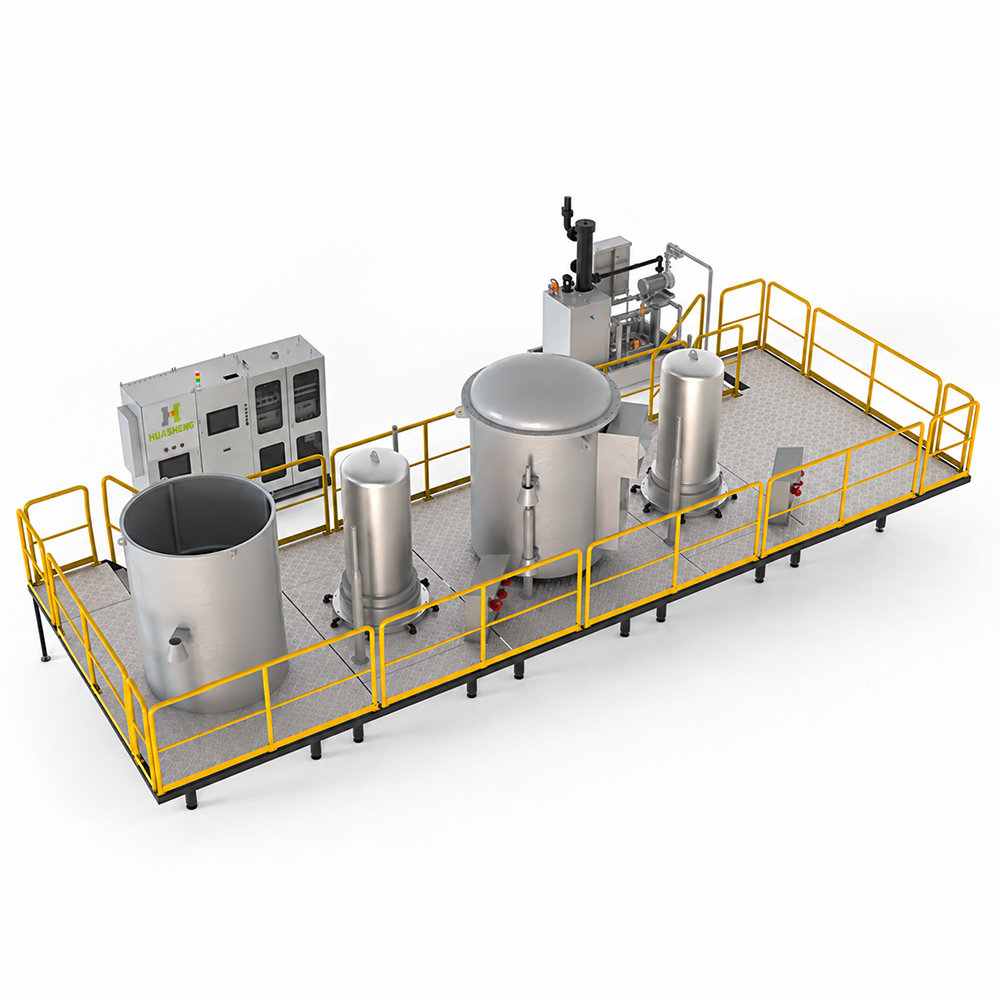
CVA 440 L Chemical Vapor Aluminizing Equipment

15 +
Years Experience

700 +
Installations Worldwide

OEM
Solutions Available

30 +
Countries & Regions
Protection for Complex Geometries
The gaseous process medium can contact external surfaces, internal cooling channels and film-cooling holes, supporting uniform protection on complex hot-section components.
Controlled Aluminide Diffusion Layer
Process parameters can be adjusted to control diffusion-layer thickness, aluminum content and coating structure according to component material and service conditions.
High-Temperature Oxidation Resistance
The aluminide layer promotes the formation of a protective Al₂O₃ scale, helping protect the substrate in high-temperature environments.
Large Working Zone and Heavy Loading
An effective working area of at least Φ740 × 1000 mm and a maximum load of 400 kg support large components, fixtures and industrial production batches.
-
One-reactor configuration
-
800 mm reactor inner diameter
-
1800 mm reactor outer diameter
-
Effective working zone ≥ Φ740 × 1000 mm
-
Maximum reactor loading of 400 kg
-
Maximum furnace temperature of 1200°C
Model |
CVA 440 L |
| Technology | Chemical Vapor Aluminizing (CVA) |
| Number of Reactors | 1 |
| Reactor Inner Diameter | 800 mm |
Reactor Outer Diameter |
1800 mm |
Effective Working Zone |
≥ Φ740 × 1000 mm |
Pressure-Rise Rate |
≤ 0.5 mbar/h |
Specified Ultimate Vacuum |
≤ 5 mbar |
| Maximum Reactor Loading | 400 kg |
| Maximum Furnace Temperature | 1200°C |
| Working Temperature | 900–1150°C |
| Temperature Uniformity | ±7°C, based on three process thermocouples |
What is chemical vapor aluminizing?
Chemical vapor aluminizing is a diffusion-coating process based on CVD technology. Reactive gaseous species deliver aluminum to the component surface, where an aluminide diffusion layer forms through chemical reaction and interdiffusion.
What components can be processed in the CVA 440 L?
Typical parts include turbine blades, engine hot-section components and other high-temperature parts with complex external surfaces or internal cooling passages.
Can the process coat internal channels?
Yes. CVA is suitable for complex shapes and can be used to coat internal cooling channels and film-cooling holes when the process and fixturing are properly designed.
What is the working-zone size?
The specified effective working zone is at least Φ740 × 1000 mm.
What is the maximum loading capacity?
The maximum reactor loading is 400 kg. Actual loading depends on part size, fixture mass, gas-flow requirements and process qualification.
What temperature does the CVA 440 L operate at?
Its specified working temperature range is 900°C to 1150°C, with a maximum furnace temperature of 1200°C.
Which aluminide coating should I choose?
Selection depends on substrate alloy, operating temperature, oxidation and hot-corrosion conditions, component geometry and the required service life. Submit the material grade, drawing and performance specification for process evaluation.