


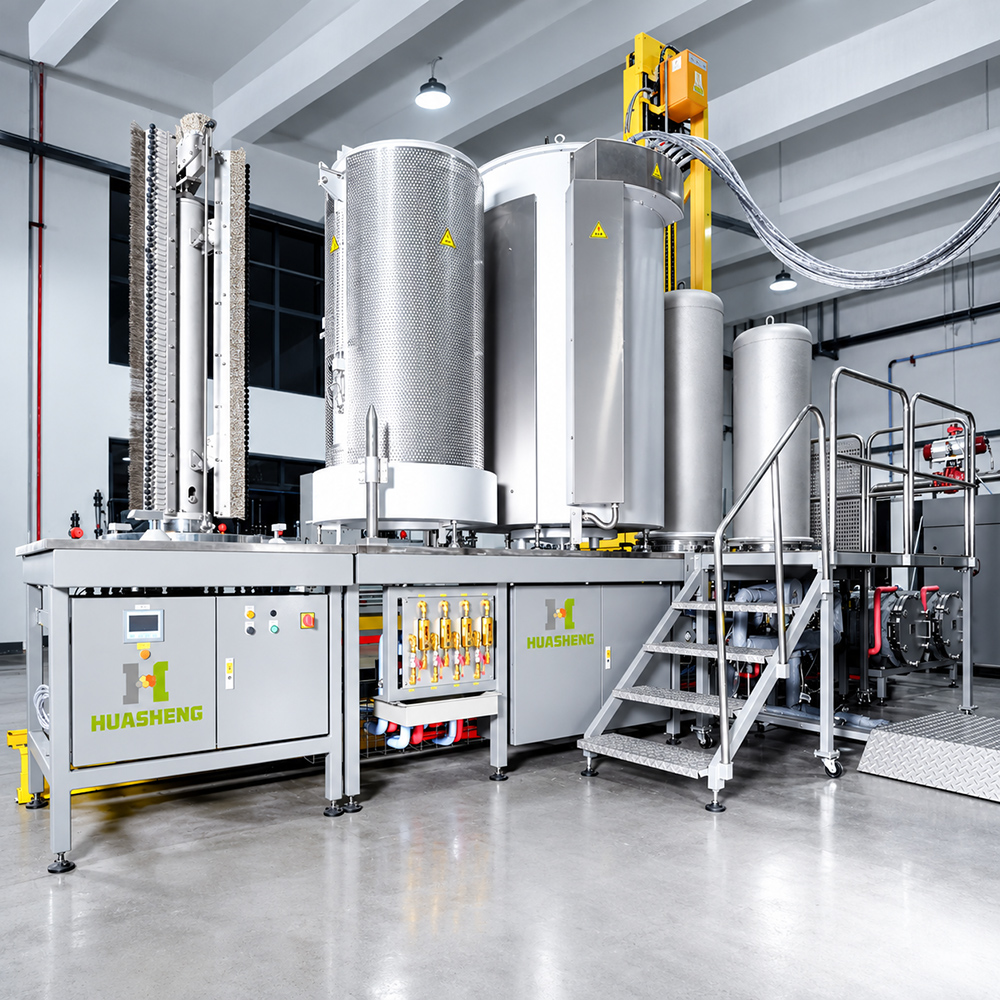
CVA 190 L Chemical Vapor Aluminizing Equipment

15 +
Years Experience

700 +
Installations Worldwide

OEM
Solutions Available

30 +
Countries & Regions
Compact CVA Production
The Φ390 mm work zone is suited to smaller turbine blades and hot-section components, helping customers match equipment capacity to actual component dimensions.
Treatment of Internal and External Surfaces
The gas-phase process can reach complex shapes and internal passages that are difficult to treat with line-of-sight coating methods.
Aluminide Diffusion Protection
The process forms a metallurgically bonded aluminide diffusion layer that supports resistance to high-temperature oxidation and hot corrosion.
Flexible Work-Zone Height
An available work-zone height of 825–925 mm supports different component and fixture configurations within the specified reactor capacity.
-
One-reactor configuration
-
Usable volume per reactor up to 110 liters
-
530 mm reactor outer diameter
-
1600 mm reactor outside length
-
390 mm work-zone diameter
-
825–925 mm work-zone height
Model |
CVA 190 L |
| Technology | Chemical Vapor Aluminizing (CVA) |
| Number of Reactors | 1 |
| Usable Volume per Reactor | Up to 110 L |
Reactor Outer Diameter |
530 mm |
Work-Zone Height |
825–925 mm |
| Reactor Capacity | Φ390 × 925 mm height |
| Hearth Loading | Up to 400 kg |
What is the CVA 190 L used for?
It is used to form aluminide diffusion layers on turbine blades, engine hot-section parts and other components requiring resistance to high-temperature oxidation and hot corrosion.
What is the usable volume of the CVA 190 L?
The brochure specifies a usable volume of up to 110 liters per reactor.
What component size can the system accommodate?
The specified work-zone diameter is 390 mm and the work-zone height is adjustable from 825 to 925 mm. The listed reactor capacity is Φ390 × 925 mm height.
What is the maximum hearth loading?
The specified hearth loading is up to 400 kg. The permissible component load must account for fixture weight and process requirements.
Can the CVA 190 L coat cooling channels and holes?
The CVA process is suited to complex shapes and internal passages. Final coverage depends on component design, gas-flow access, fixturing and a validated coating cycle.
How does CVA protect turbine components?
The process forms an aluminum-rich diffusion layer that promotes a protective Al₂O₃ scale. This scale helps shield the substrate from high-temperature oxidation and corrosive environments.
How do I choose between CVA 190 L and CVA 440 L?
Start with the component envelope, fixture size, batch quantity and required process specification. CVA 190 L suits smaller workpieces, while CVA 440 L provides a much larger working zone for larger components and production fixtures.