• icon_youtube
  • Linkedin
  • Leave Your Message
    0%

    Evaporation deposition is a pretty neat method used to put thin films onto surfaces, kind of like coating something with a super thin layer. So, in a vacuum chamber, you take a solid material and heat it up—sometimes with electricity, other times with an electron beam—until atoms or molecules break away and turn into vapor. That vapor then zips through the chamber and cools down when it hits a colder surface, slowly building up a tiny coating—often just a few nanometers thick. Honestly, the idea behind it is simple enough, but the details can get pretty tricky. Depending on what you’re working with, the source might be heated up by resistance heating or an electron beam, depending on the material and the equipment at hand.

    Now, because vapor tends to go straight and not bend around corners, tricky shapes or recessed areas might not get coated evenly—small mistakes here can really make a difference. That’s why operators keep a close eye on stuff like the pressure inside the chamber, the temperature of the source, how quickly the film is depositing, and the film’s thickness. Also, prepping the surface properly matters—things like dust or oil can mess up how well the coating sticks or even leave visible bumps underneath.

    This technique is often used for things like optical coatings or specific electronic films, but it’s not a one-size-fits-all solution. When you compare it to Chemical Vapor Deposition (CVD), evaporation deposition mainly relies on physically moving vapor onto the surface, rather than chemical reactions happening in a gas phase. That’s a key difference, but honestly, it doesn’t tell you which method makes a better coating—that’s more about the specifics of each case. Sometimes measurements look good, but the coating might still peel off easily. So, getting consistent, reliable results means using well-calibrated tools, setting everything up the same way each time, and inspecting the final surface carefully. Even then, a perfectly flawless film is not guaranteed. Knowing the ins and outs—like how heat turns into vapor and then deposits—really helps in understanding what this process can do well and where it falls short.
    How Does Evaporation Deposition Work?

    What Evaporation Deposition Is

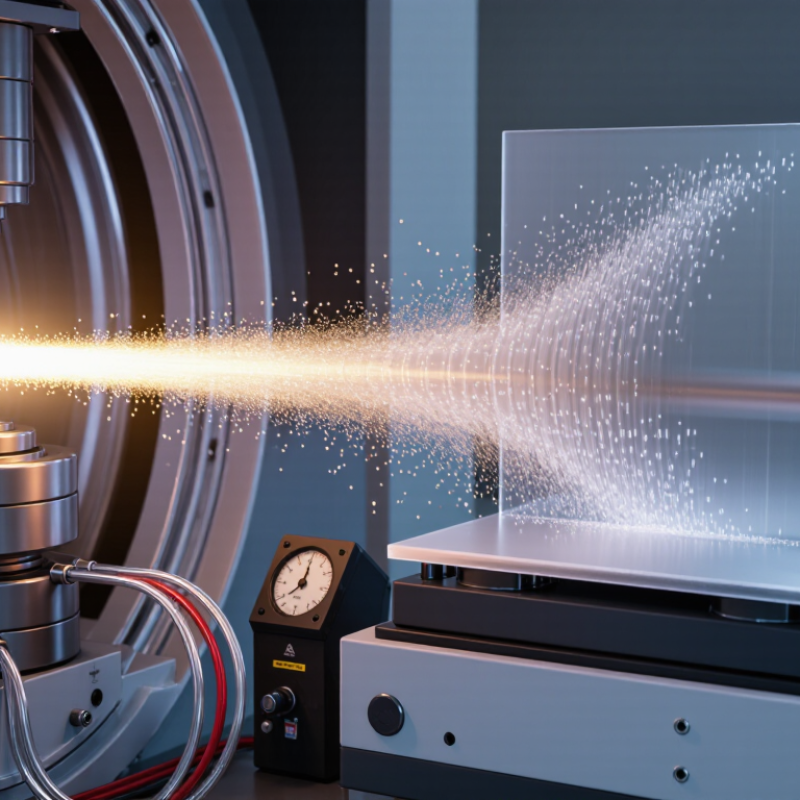
    Evaporation deposition is a physical vapor deposition process that forms a thin coating on a surface. A solid source material is heated inside a vacuum chamber until some of it becomes vapor. The vapor travels through the chamber and condenses on a cooler substrate, such as a glass slide or metal part. In simple terms, the source becomes vapor, then a film. It sounds straightforward. Control takes practice.

    Vacuum reduces collisions between vapor particles and gas molecules, helping more material reach the substrate. Heating may come from electrical resistance or an electron beam, depending on the material and setup. Operators monitor the deposition rate and thickness, often with a sensor positioned near the growing film. Even small changes matter. A rate that shifts during a run can affect coating uniformity, while substrate position can leave one area thicker than another.

    Thin Film Deposition Equipment typically includes a vacuum chamber, a material source, a heating system, and monitoring instruments. The method is useful for applying thin layers in optics, electronics, and research samples. However, evaporation is directional: surfaces hidden behind edges or features may receive little coating. That limitation is easy to overlook. Material choice, heat sensitivity, and adhesion also influence results, so a clean substrate and carefully recorded process settings are important. No single recipe works for every surface.

    How Evaporation Deposition Works

    In vacuum, a source material is heated until it evaporates. The vapor travels through the chamber and condenses on a substrate, forming a thin film.

    Illustrative example: at a constant deposition rate of 1 Å/s (0.1 nm/s), the idealized film thickness increases by 6 nm per minute. Actual rates and thickness may vary with material, equipment, and process conditions.

    Preparing the Substrate and Vacuum Chamber

    Before loading, inspect the substrate under bright, angled light. Dust, fingerprints, and dried cleaning marks can affect adhesion or leave visible defects. Handle polished surfaces with clean gloves or suitable tweezers, touching only the edges. Choose a cleaning method compatible with the material; a solvent suitable for glass may damage a polymer surface. Cleanliness matters here. Dry the substrate fully, because trapped moisture can release gas inside the chamber.

    Secure the substrate on a clean holder and check its position relative to the evaporation source. Poor alignment may cause uneven coating or leave part of the surface in shadow. Avoid clamping so tightly that thermal expansion becomes a problem. A quick visual check helps, though it cannot reveal every residue. This step is easy to rush.

    Before closing the chamber, check that seals and internal shields are clean and properly seated. Remove loose flakes or debris using the lab’s approved procedure. Pump down gradually and watch the pressure trend, not just the final reading. A slow or unstable drop can point to moisture, outgassing, or a sealing issue. Pause and investigate rather than assuming the chamber is ready.

    Heating the Source Material Until It Vaporizes

    Evaporation deposition forms a thin film by heating a solid source until its atoms or molecules enter the vapor phase. The process usually takes place in a vacuum chamber, where fewer gas particles interfere with the traveling vapor. A heater raises the source temperature; depending on the equipment, resistance heating or an electron beam may supply the energy. The vapor moves toward a cooler substrate and condenses into a coating. It is a simple picture, but real films can be less uniform near edges.

    As the source heats, operators monitor temperature and deposition rate to help control film thickness. The vapor mostly travels in straight lines, so substrate position and surface shape matter. Poor temperature control can cause uneven growth or unwanted material loss. This is a physical process, unlike Chemical Vapor Deposition Types, which rely on chemical reactions involving vapor-phase precursors. That distinction is useful, though the boundary between process choices is not always obvious in practice.

    Tips: Keep the source and substrate surfaces clean, and check that the substrate faces the vapor path. Use a suitable thickness monitor where available. Small setup changes can affect the coating, so record them carefully.

    How Vapor Travels Through the Chamber

    How Does Evaporation Deposition Work?

    How Vapor Travels Through the Chamber

    Inside an evaporation chamber, a source is heated until its material becomes vapor. The chamber’s low pressure limits collisions with air molecules, so many vapor atoms travel in nearly straight paths. This is often called line-of-sight transport. They cross the space and condense on a cooler substrate, building a thin film atom by atom.

    The path is not perfectly simple. Some atoms strike chamber walls or shields instead of the substrate. Others scatter when residual gas remains, which can affect the coating’s thickness and uniformity. Source position, substrate distance, and chamber shape all matter. In practice, a rotating substrate may receive a more even coating, though rotation cannot fix every setup issue. Thin Film Deposition Techniques rely on careful control of these details.

    Tips: Keep the source-to-substrate path clear, and check that the thickness monitor is positioned appropriately. A small obstruction can change the arriving vapor pattern. Don’t assume a smooth-looking film is uniform; measurements can reveal what the eye misses.

    Condensation and Thin-Film Growth on the Substrate

    How Does Evaporation Deposition Work?

    Condensation and Thin-Film Growth on the Substrate

    In evaporation deposition, a source material is heated in a vacuum until atoms or molecules enter the vapor phase. They travel toward the substrate, often along fairly direct paths. When they arrive, they lose energy and condense on its surface. A clean glass slide might look unchanged, even as a thin layer begins to form. Tiny details matter.

    At first, deposited particles settle into small clusters called nuclei. These clusters grow, meet, and gradually form a continuous film. Substrate temperature, surface cleanliness, and deposition rate all affect how that film develops. Too much rate can encourage rough growth; a cool or contaminated surface may weaken adhesion. The outcome also depends on geometry: raised edges can block incoming vapor, leaving shaded areas thinner. That limitation is easy to overlook.

    Film thickness monitors can track deposition, but the reading may not perfectly match the coating at every point. Small placement differences matter. Evaporation is also distinct from Plasma Chemical Vapor Deposition, which forms films through gas-phase chemical reactions rather than simply condensing vaporized source material. In practice, a smooth-looking coating does not reveal every hidden flaw, so surface inspection and process records remain useful.

    Controlling Film Properties During Deposition

    How Does Evaporation Deposition Work?
    Controlling Film Properties During Deposition

    Evaporation deposition turns a solid source into vapor inside a vacuum chamber. The vapor travels toward a substrate and condenses as a thin film. During this journey, process settings shape the film’s thickness, uniformity, and structure.

    Small changes matter. A faster deposition rate can shorten production time, but it may make thickness control harder. Substrate temperature affects how atoms move after landing. More mobility can improve film density, yet excessive heat may damage temperature-sensitive materials. Source-to-substrate distance and substrate rotation also influence how evenly vapor reaches the surface.

    Pressure matters, too. Poor vacuum can increase collisions or introduce contaminants, affecting adhesion and film quality. Operators commonly track thickness with a quartz crystal monitor, but its reading may not match the coating on every part. Calibration against the actual substrate helps. Even then, results can vary across a large chamber. That uncertainty deserves attention, not hand-waving. A practical process balances rate, heat, and uniformity, then checks the finished film for defects and thickness variation.

    How Does Evaporation Deposition Work? - Controlling Film Properties During Deposition

    In evaporation deposition, a material is heated under vacuum until atoms or molecules enter the vapor phase and travel to a substrate, where they condense into a thin film. The ranges below are illustrative and depend on the material, equipment, and process requirements.

    Process dimension Typical values or approach Influence on film properties How it is controlled
    Chamber pressure Often around 10−6 to 10−5 Torr during deposition; the required pressure varies by process. Lower pressure reduces vapor collisions and contamination from residual gases, helping deposited material travel to the substrate. Use vacuum pumps and a calibrated pressure gauge; allow the chamber to reach the specified process pressure before deposition.
    Deposition rate A commonly used working range is approximately 0.1–2 nm/s, though some processes operate outside it. Rate can affect film continuity, grain development, composition, and the time available for surface atoms to rearrange. Adjust source power or heating current and monitor the rate with a quartz crystal microbalance or another calibrated method.
    Film thickness Thin films may range from a few nanometers to several hundred nanometers; application requirements determine the target. Thickness affects optical transmission, electrical resistance, coverage, and mechanical behavior. Integrate the measured deposition rate over time and verify thickness with an appropriate method, such as profilometry or ellipsometry.
    Substrate temperature May be near room temperature or intentionally elevated, depending on the substrate and film material. Higher temperature can increase surface mobility and alter crystallinity, adhesion, stress, and grain size; excessive heat may damage the substrate. Use a heater or cooling stage and monitor the substrate temperature with a suitable sensor.
    Substrate preparation Clean and dry the substrate using a method compatible with its material and intended film. Surface contamination can reduce adhesion and cause defects, nonuniformity, or poor electrical contact. Apply a validated cleaning procedure, minimize handling, and load the substrate promptly into the clean chamber.
    Source-to-substrate geometry Set by the deposition system; evaporation is largely line-of-sight, so source position and substrate orientation matter. Geometry influences thickness uniformity and step coverage, especially on recessed or irregular surfaces. Position the substrate consistently; use rotation or planetary motion when needed to improve uniformity.
    Material and source choice Thermal or electron-beam heating is selected according to the source material’s properties and process needs. The source method and material behavior can affect deposition stability, composition, and the likelihood of spitting or contamination. Choose a compatible source and crucible, ramp power gradually, and condition the source before opening the shutter.
    Residual gas and contamination Keep the chamber, fixtures, and source clean; acceptable residual-gas levels depend on film sensitivity. Oxygen, water vapor, and other contaminants can change film composition or impair adhesion and performance. Maintain clean chamber surfaces, use suitable pump-down procedures, and monitor residual gases when the application requires it.

    WCC800 Coating Equipment: A Practical Guide to the Sputter Deposition Process

    Sputter deposition forms a coating by ejecting atoms from a target and condensing them onto components inside a vacuum chamber. In a DC+HiPIMS system, conventional direct-current sputtering is combined with short, high-power pulses that increase ionization of the sputtered material. Technical reviews, including Gudmundsson et al. in *Journal of Physics D: Applied Physics* (2011), describe HiPIMS target power densities reaching hundreds of watts per square centimetre and, in some configurations, around 1 kW/cm². Actual settings depend on the target, pulse pattern and chamber conditions. Greater ionization can help produce dense films with strong adhesion, while controlled temperature and pressure support repeatable results.

    For production, the equipment’s modular layout and automated controls simplify operation and maintenance, while adaptable loading accommodates small batches, mixed specifications and complex-shaped parts. It can deposit coatings such as WC and TiAlN on both tools and general components; selecting the coating and process recipe for the substrate and application is essential. Precise temperature and pressure regulation helps limit variation between runs, and stable sputtering conditions reduce the risk of defects such as peeling. This makes the system suitable for coating workflows that need flexibility without sacrificing consistency across different part geometries.

    FAQS

    What is evaporation deposition?

    It is a physical vapor deposition process. A solid material is heated in a vacuum, then vapor condenses into a thin film on a cooler surface.

    Why is a vacuum used?

    The vacuum reduces collisions with gas molecules. This helps more vapor reach the substrate, though it does not guarantee an even coating.

    What equipment does the process use?

    A typical setup includes a vacuum chamber, material source, heating system, and monitoring instruments. A sensor can track film growth.

    Which surfaces can be coated?

    Common examples include glass slides and metal parts. The process is used for optics, electronics, and research samples.

    Why can coating thickness vary?

    Deposition rate changes and substrate position can affect thickness. One area may receive more material than another. Small shifts matter.

    How should a substrate be prepared?

    Inspect it under bright, angled light. Remove dust, fingerprints, and cleaning marks using a method compatible with its material.

    Why does substrate placement matter?

    Evaporation is directional. Edges or features can hide areas from the vapor, leaving them lightly coated or uncoated.

    What should be checked before pumping down?

    Secure the substrate without clamping too tightly. Check seals, shields, and chamber cleanliness, then watch the pressure trend for instability.

    Is one process recipe suitable for every surface?

    No. Material choice, heat sensitivity, adhesion, and setup all affect results. A visual check helps, but it can miss residue.

    Conclusion

    Evaporation deposition is a physical process used to create a thin film on a surface. First, the substrate is cleaned and placed inside a vacuum chamber, where reduced pressure helps limit contamination and allows vapor to travel with fewer interruptions. A source material is then heated until it vaporizes, producing atoms or molecules that move through the chamber.

    When the vapor reaches the cooler substrate, it condenses and gradually forms a thin coating. The film’s thickness and characteristics depend on factors such as the source temperature, deposition time, chamber pressure, and distance between the source and substrate. By adjusting these conditions, the process can be tailored to produce films with specific properties and uniformity. Careful preparation and monitoring throughout evaporation deposition help support consistent film growth and reliable results.

    Evelyn

    Evelyn

    Evelyn is a dedicated marketing professional at Guangdong HUASHENG Nanotechnology Co., Ltd., a leading domestic supplier renowned for its advanced nanocoating solutions. With a strong background in engineering and a passion for innovation, Evelyn possesses an exceptional understanding of the......
    Previous 2026 Best Physical Vapor Deposition Coating Types?